By Admin / 23 Dec 2025
Water tanks are widely used for residential, commercial, agricultural, and industrial water storage due to their durability, lightweight design, and corrosion resistance. Understanding the plastic water tank manufacturing process helps customers, investors, and entrepreneurs appreciate the quality, strength, and technology behind these essential products.
Plastic water tanks are mainly manufactured using rotational moulding (roto moulding) technology, which produces seamless, strong, and leak-proof tanks. The process ensures uniform wall thickness, long service life, and excellent resistance to UV rays, weather conditions, and chemicals.
Most high-quality tanks are made from food-grade polyethylene materials such as LLDPE, HDPE, or MDPE, ensuring safe storage of potable water.
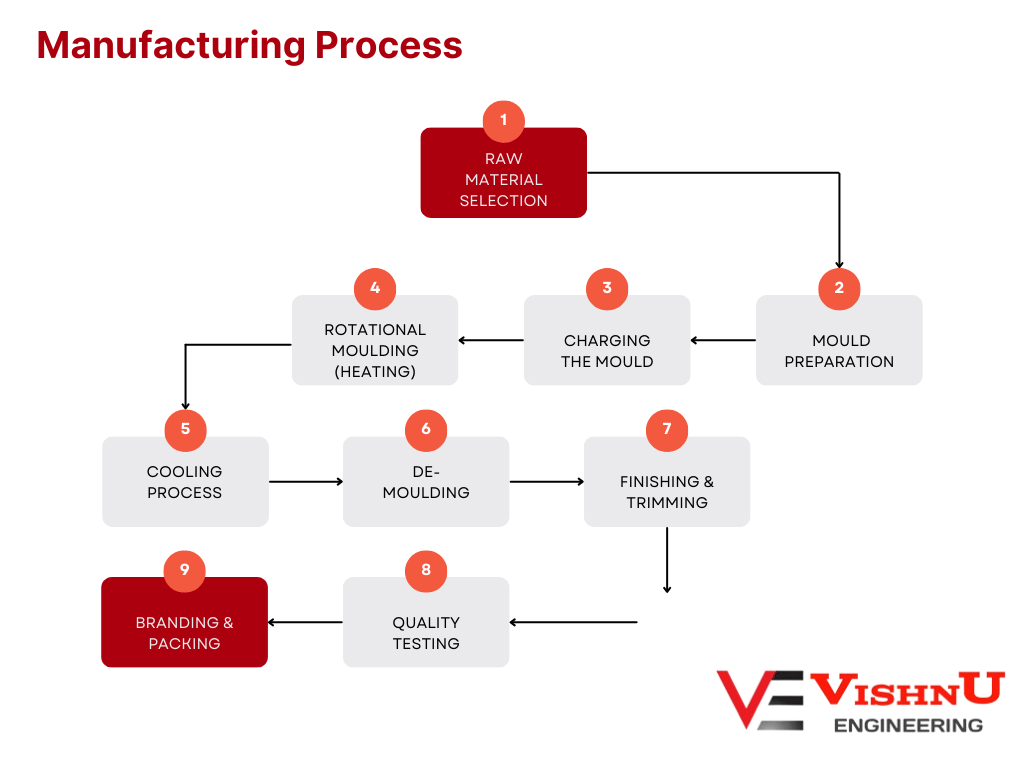
The process begins with mixing plastic granules with color masterbatches and additives. For multi-layer tanks, separate material mixtures are prepared for each layer. Accurate weighing ensures consistent thickness and strength.
The prepared raw material is loaded into a specially designed metal mould. These moulds determine the tank’s shape, size, capacity, and surface finish. Once loaded, the mould is securely closed.
The closed mould is placed inside a rotational moulding oven. The mould rotates slowly on two axes while heat is applied. As the temperature rises, the plastic melts and evenly coats the inner surface of the mould.
After heating, the mould is moved to a cooling chamber. Controlled air or water cooling allows the plastic to solidify evenly. Proper cooling prevents deformation, cracks, and shrinkage.
Once cooled, the mould is opened carefully, and the plastic water tank is removed. At this stage, the tank has achieved its final shape and strength.
Excess plastic material is trimmed, and the edges are smoothened. Tank openings, lids, outlets, and threaded connections are fitted according to design specifications.
The plastic water tank manufacturing process is a well-engineered and reliable method that produces durable, hygienic, and long-lasting water storage solutions. From raw material preparation to final quality testing, every step plays a crucial role in ensuring tank strength and performance.
With growing demand for safe water storage, advanced manufacturing technology, and strict quality control, plastic water tanks continue to be the preferred choice across multiple sectors.

Request A Quote